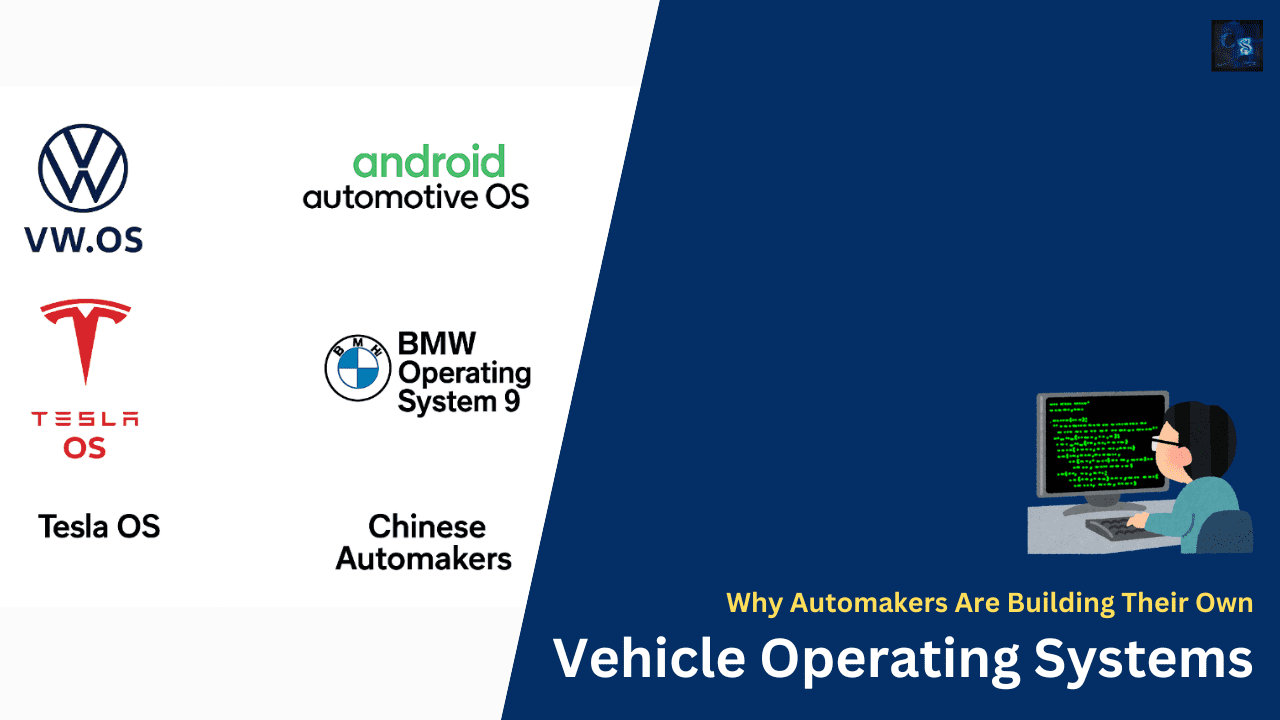
Hello, everyone. Welcome back to our blog. In this article, I will discuss why automakers are building their own vehicle operating systems, the challenges, and the opportunities.
Ask questions if you have any electrical, electronics, or computer science doubts. You can also catch me on Instagram – CS Electrical & Electronics
- Kalman Filter Applications in ADAS (Advanced Driver Assistance Systems)
- Top 10 Software-Defined Vehicle (SDV) Project Ideas To Build In 2025
- Top 10 Software-Defined Vehicle (SDV) Projects You Should Know About
Why Automakers Are Building Their Own Vehicle Operating Systems
The automotive industry is undergoing a historic transformation. Once purely mechanical machines, vehicles have become sophisticated electronic systems packed with sensors, connectivity features, infotainment systems, and advanced driver-assistance technologies. At the heart of this evolution lies software, and more specifically, the operating system (OS) that manages how a car behaves, interacts, and evolves over time.
In the same way that an operating system powers our smartphones and computers, vehicle operating systems are now becoming the core enabler of the Software-Defined Vehicle (SDV). This shift has motivated major automakers like Volkswagen and Mercedes-Benz to develop their own proprietary operating systems—VW.OS, MB.OS, and more. But why this sudden move to become software developers? Let’s explore the reasons, technologies, and strategies behind this paradigm shift.
What Is a Vehicle Operating System?
A vehicle operating system is a centralized software platform that controls and coordinates all digital functions inside a modern car. From infotainment systems and navigation to safety-critical systems such as braking and steering, the OS serves as the command center for all vehicle functions.
Unlike traditional embedded software tied to individual ECUs (Electronic Control Units), a vehicle OS allows for unified control, modular updates, and interoperability between different systems. It supports real-time data processing, secure communication between sensors and actuators, and ensures seamless interaction with the cloud, apps, and user interfaces.
In essence, a vehicle OS is the digital brain that transforms a vehicle from a static machine into a dynamic, updatable, and intelligent platform.
Traditional Automotive Software Architecture
Historically, vehicles have used a distributed software architecture with dozens of ECUs, each developed by different Tier-1 suppliers. Each ECU had its own firmware, often written in different programming languages, and communication between these systems was limited to CAN, LIN, or FlexRay protocols.
This approach created massive fragmentation, poor scalability, and limited innovation. Over-the-air (OTA) updates were impossible or limited to infotainment systems. Automakers had little control over software updates, security patches, or user experience.
Moreover, the cost and complexity of maintaining these systems increased with every vehicle model. This made the industry ripe for a digital overhaul, and a unified OS was the natural solution.
Why Automakers Are Building Their Own OS
The decision to build a vehicle OS in-house is driven by several compelling factors:
01. Need for Integration: Modern vehicles require a unified software platform that can handle diverse functionalities—from navigation and entertainment to battery management and autonomous driving. A single OS allows for tight integration across all systems, leading to a more cohesive and responsive user experience.
02. Faster Innovation and OTA Updates: Tesla set a new benchmark by rolling out frequent OTA updates that improve performance, add features, or fix bugs. To replicate this agility, automakers need control over the entire software stack—something only a proprietary OS can provide.
03. Data Ownership and Cybersecurity: With vehicles generating gigabytes of data per hour, automakers want to retain control over this data rather than hand it to third-party suppliers or tech companies. A custom OS provides better control over data privacy and cybersecurity.
04. Monetization Opportunities: Future vehicles will offer in-car purchases, subscriptions for features like heated seats or autonomous capabilities, and third-party apps. A vehicle OS becomes the gateway for all these services, generating new revenue streams.
05. Reduced Dependency on Tier-1 Suppliers: By developing their own OS, automakers can control the software development lifecycle, reduce costs, and manage updates more efficiently. This also positions them to attract top tech talent.
06. Support for AI and Autonomous Features: Self-driving capabilities require real-time sensor fusion, neural networks, and massive computational power. A vehicle OS optimized for these tasks is essential to ensure performance and safety.
07. Scalability Across Models: A unified OS allows automakers to scale features across multiple brands and models, reducing development time and costs.
Case Studies: How Major Automakers Are Approaching Vehicle OS
01. VW.OS (Volkswagen Group):
Volkswagen’s proprietary OS is being developed by its software subsidiary, CARIAD. The goal is to create a unified platform across its brands—Volkswagen, Audi, Porsche, and more. VW.OS will handle everything from infotainment to autonomous driving features and will be capable of OTA updates.
However, VW.OS has faced delays due to complexity and talent shortages. Still, the long-term vision remains strong: to reduce supplier dependence and turn vehicles into mobile digital ecosystems.
02. MB.OS (Mercedes-Benz):
MB.OS is Mercedes-Benz’s in-house operating system designed to provide seamless, intelligent, and luxurious user experiences. It supports NVIDIA’s Drive platform, advanced navigation with 3D graphics, and high-performance AI for driver assistance.
Mercedes-Benz emphasizes personalization and OTA updates. MB.OS also integrates third-party services like music streaming while maintaining control over core vehicle functionalities.
03. Android Automotive OS (AAOS):
Google’s AAOS is an open-source OS designed for embedded use in vehicles. Unlike Android Auto, which mirrors your phone, AAOS is a native platform within the car. Companies like Volvo, General Motors, and Renault have adopted it.
While easy to implement, AAOS raises concerns about data ownership and future control, which is why many OEMs prefer hybrid models—combining AAOS for infotainment with proprietary systems for core functions.
04. Tesla OS:
Tesla’s operating system is fully homegrown, enabling seamless OTA updates, real-time performance improvements, and integration with its autonomous driving features. Tesla’s vertical software integration is the gold standard for the industry.
05. BMW Operating System 9:
Built on Linux and enhanced with Android services, BMW OS 9 supports OTA updates, app integration, and cloud connectivity. BMW plans to roll it out across multiple vehicle segments.
06. Chinese Automakers:
Companies like NIO, Xpeng, and BYD are investing heavily in their own operating systems, often leveraging AI and cloud connectivity to deliver tech-rich user experiences.
Modern Vehicle OS Architecture
Today’s vehicle OS architecture is moving toward central computing. Instead of having 100+ ECUs, automakers are integrating functionality into centralized domains or zonal controllers. This requires an OS that can:
- Handle real-time data from sensors
- Prioritize safety-critical functions
- Run containerized apps using Docker or similar technologies
- Interface with cloud platforms like AWS or Azure
- Ensure cybersecurity through encrypted protocols and firewalls
Many vehicle OSs now support middleware layers, virtualization, and microservices architecture to make software deployment faster and more modular.
Challenges in Building a Vehicle OS
Despite the benefits, building a vehicle OS is incredibly difficult:
- Safety and Compliance: Automotive systems must meet strict standards like ISO 26262 and ASPICE, which makes development slow and complex.
- Real-Time Performance: Ensuring that critical functions (e.g., braking) respond in milliseconds is non-negotiable.
- Scalability: An OS must work seamlessly across vehicle lines—from small hatchbacks to premium SUVs.
- Cybersecurity: Vehicles are vulnerable to hacking. The OS must include intrusion detection, sandboxing, and secure boot mechanisms.
- Talent and Cost: Developing an OS requires top-tier software engineers, who are in high demand.
Opportunities and the Road Ahead
Vehicle operating systems will shape the future of mobility. They offer a platform for:
- Personalized experiences: Adjust seats, music, and climate based on driver profiles.
- Subscription services: Pay-as-you-go features like extra horsepower or autopilot.
- In-car app stores: Similar to smartphones, users can download apps for productivity, entertainment, or travel.
- Autonomous driving: As vehicles move toward Level 4 and 5 autonomy, the OS will be critical in managing complex AI models.
In the coming years, we’ll see collaborations, open-source initiatives, and perhaps even regulation around vehicle OS interoperability.
Conclusion: From Automakers to Software Powerhouses
Automakers are no longer just building cars—they’re building platforms. The decision to develop proprietary operating systems is more than a technological choice; it’s a strategic transformation. With vehicle OSs like VW.OS and MB.OS, automakers are positioning themselves for a future where software defines value, not just horsepower.
As vehicles become smarter, connected, and autonomous, the OS will be the beating heart of this digital mobility era. The road ahead is exciting—and it’s paved with code.
This was about “Why Automakers Are Building Their Own Vehicle Operating Systems“. Thank you for reading.
Also, read:
- “Mother of All Deals”: How The EU–India Free Trade Agreement Can Reshape India’s Economic Future
- 10 Free ADAS Projects With Source Code And Documentation – Learn & Build Today
- 100 (AI) Artificial Intelligence Applications In The Automotive Industry
- 1000+ Automotive Interview Questions With Answers
- 2024 Is About To End, Let’s Recall Electric Vehicles Launched In 2024
- 2026 Hackathons That Can Change Your Tech Career Forever
- 50 Advanced Level Interview Questions On CAPL Scripting
- 7 Ways EV Batteries Stay Safe From Thermal Runaway