“EEE has no future.”
“You must switch to IT to survive.”
“Core jobs don’t pay.”
If you are an Electrical & Electronics Engineering (EEE) student or professional, you have probably heard these statements many times. Over the last decade, the IT and software boom overshadowed core engineering fields. As a result, thousands of talented EEE engineers moved away from their domain—not because EEE lacked opportunities, but because nobody showed them the roadmap.
The reality in 2026 and beyond is very different.
The world is rapidly electrifying:
- Electric Vehicles replacing ICE vehicles
- Renewable energy replacing fossil fuels
- Smart grids replacing conventional power networks
- Power electronics replacing mechanical control
- Automation replacing manual industry
At the heart of all this transformation stands EEE engineers.
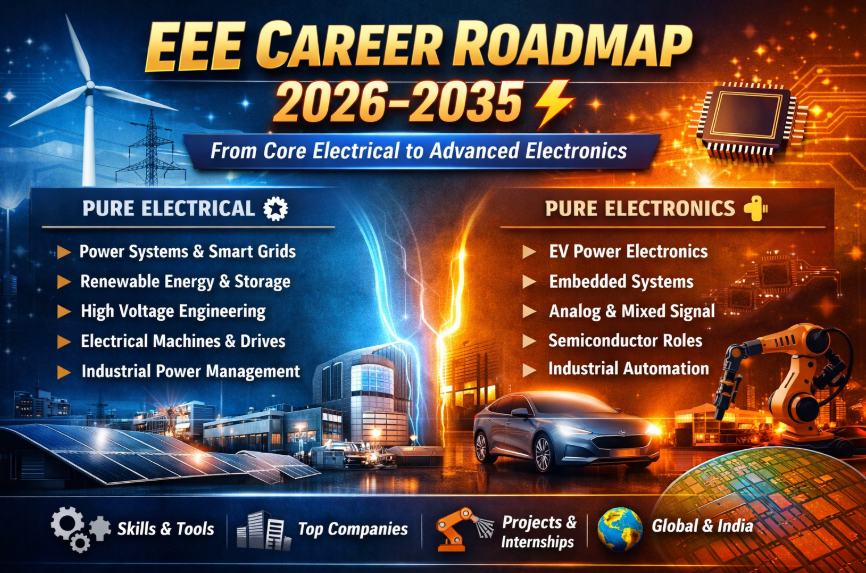
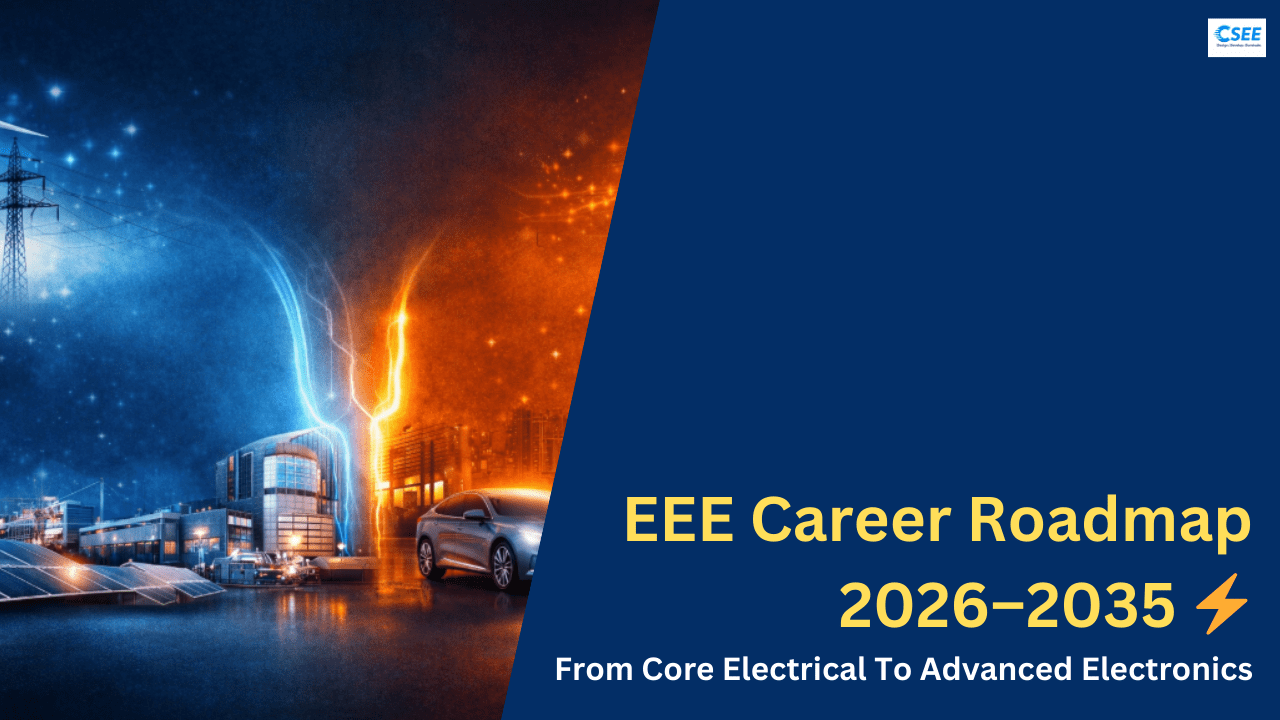
This article is a complete, honest, and practical roadmap for EEE careers—covering:
- Pure Electrical domains (5 paths)
- Pure Electronics domains (5 paths)
- Required skills, tools, and software
- Companies hiring
- Career progression
- Salary growth
- India vs global opportunities
- Mistakes to avoid
This is not motivational fluff. This is a field-tested career map.
SECTION 1: Understanding EEE in 2026
EEE is unique because it sits at the intersection of:
- Energy
- Hardware
- Control
- Electronics
- Industrial systems
Unlike pure Electronics or pure Mechanical, EEE engineers can move across:
- Power
- EV
- Automation
- Semiconductors
- Embedded systems
The key is choosing a domain early and building depth.
PART A: PURE ELECTRICAL CAREER ROADMAP (5 DOMAINS) ⚙️
1. Power Systems & Smart Grids
Power Systems engineers work on the backbone of electricity supply — generation, transmission, and distribution of power. This role ensures that electricity generated from power plants reaches homes, industries, and cities safely, reliably, and efficiently. With rising demand and complex networks, modern power systems are no longer static; they are dynamic and data-driven.
In day-to-day work, engineers analyze load flow, short circuits, system stability, and protection coordination. They design substations, plan transmission lines, configure protection relays, and monitor grids using SCADA systems. Smart grid engineers also work with communication protocols like IEC 61850 and integrate sensors such as PMUs for real-time monitoring.
By 2026 and beyond, power systems are becoming digital power networks. Smart grids, AI-based fault detection, and cybersecurity for electrical infrastructure are creating long-term demand. This role offers stability, responsibility, and strong career longevity, especially in utilities and large EPC companies.
What This Domain Is About
Power Systems deals with:
- Generation (thermal, hydro, nuclear, renewable)
- Transmission (HV, EHV, HVDC)
- Distribution
- Protection & control
- Smart grids & digital substations
In 2026, power systems are no longer “boring utilities.” They are becoming software-defined, sensor-driven, AI-assisted networks.
Key Skills Required
Core Fundamentals
- Power system analysis
- Load flow, short circuit analysis
- Power system stability
- Protection systems
Tools & Software
- ETAP
- PSCAD
- PSS/E
- PowerWorld
- MATLAB (Simulink)
Emerging Skills
- Smart grid communication (IEC 61850)
- SCADA
- PMUs (Phasor Measurement Units)
- Cybersecurity for power systems
Companies Hiring
Global
- Siemens Energy
- ABB
- GE Grid Solutions
- Schneider Electric
- Hitachi Energy
India
- Power Grid Corporation of India
- NTPC
- Tata Power
- L&T
- State utilities (transco/discom)
Career Path
- Graduate Engineer → Protection / Planning Engineer
- Senior Engineer → Grid Specialist
- Lead Engineer → Grid Architect
- Manager / Consultant / Independent expert
Salary Outlook
- Entry (India): ₹4–8 LPA
- Mid-level: ₹12–25 LPA
- Global roles: $80k–150k
2. Renewable Energy & Energy Storage
Renewable energy engineers focus on integrating solar, wind, and hybrid energy systems into the electrical grid. This role supports the global transition toward clean and sustainable power by designing systems that reduce carbon emissions while maintaining grid reliability.
Engineers work on solar PV plant design, wind farm electrical layouts, inverter selection, grid interconnection studies, and energy storage sizing. They collaborate with power electronics teams, grid operators, and policymakers to ensure renewable energy can be absorbed by existing networks without instability.
With countries committing to net-zero targets, renewable energy and battery storage will dominate new power installations. This domain offers rapid growth, global mobility, and exposure to future technologies like hydrogen and microgrids, making it one of the safest EEE career paths.
Why This Domain Is Exploding
By 2035, most countries aim for net-zero emissions. Renewable energy and storage are no longer optional.
EEE engineers are needed for:
- Solar PV system design
- Wind energy systems
- Grid integration
- Battery Energy Storage Systems (BESS)
- Hydrogen systems
Skills Required
Core
- Power electronics basics
- Power systems
- Electrical machines
Specialized
- Solar PV design (PVsyst)
- Wind turbine systems
- Inverters & converters
- BESS sizing & control
Tools
- PVsyst
- Homer
- MATLAB
- ETAP
Companies Hiring
- Vestas
- Siemens Gamesa
- Tesla Energy
- Enphase
- ReNew Power
- Adani Green
- NextEra Energy
Career Path
- Site Engineer → Design Engineer
- Grid Integration Engineer
- Energy Storage Specialist
- Renewable Energy Consultant
Future Scope
This field will not saturate for the next 20 years.
3. Electrical Machines & Drives
Electrical Machines & Drives engineers specialize in motors, generators, and motion control systems used across industries. Every EV, factory conveyor, elevator, robot, and industrial machine relies on efficient motor-drive systems.
In this role, engineers design, analyze, and control AC/DC motors, develop variable frequency drives (VFDs), and optimize efficiency and torque performance. They work with control algorithms, feedback systems, thermal analysis, and sometimes AI-based predictive maintenance.
With electrification accelerating across transport and industry, demand for high-efficiency machines and advanced drives is rising sharply. This domain combines theory, hardware, and control, offering strong opportunities in EVs, automation, and heavy industries.
Why Machines Still Matter
Every EV, robot, conveyor belt, and industrial system uses:
- Motors
- Drives
- Control systems
Machines are evolving with:
- High-efficiency motors
- Sensorless control
- AI-based predictive maintenance
Skills Required
- Electrical machines theory
- Control systems
- Power electronics
- Motor drives
Tools
- MATLAB/Simulink
- Ansys Maxwell
- PLECS
Companies Hiring
- ABB
- Siemens
- WEG
- Nidec
- CG Power
- BHEL
Career Path
- Design Engineer → Drives Engineer
- EV Motor Specialist
- R&D Engineer
- Technical Lead
4. High Voltage Engineering & Substations
High Voltage engineers work on systems that operate at extremely high voltages, typically above 33kV, including transmission lines, substations, and HVDC systems. This role is critical for transmitting bulk power over long distances with minimal losses.
Daily work includes insulation coordination, substation layout design, surge protection, testing of transformers and switchgear, and commissioning of high-voltage equipment. Engineers also ensure compliance with international standards such as IEC and IEEE.
This is a niche but highly respected domain with fewer engineers and higher responsibility. HV engineering offers excellent long-term stability, global project exposure, and premium roles in power transmission and infrastructure development.
What Makes This Domain Elite
HV engineers work on:
- HVDC
- GIS substations
- Insulation systems
- Surge protection
- Testing & commissioning
This is a high-responsibility, high-pay, low-competition field.
Skills Required
- HV engineering
- Insulation coordination
- Substation design
- Testing standards (IEC, IEEE)
Companies Hiring
- Hitachi Energy
- Siemens
- GE
- L&T
- Alstom Grid
5. Industrial Power & Energy Management
Industrial Power engineers focus on managing electrical systems inside factories, plants, and large commercial facilities. Their goal is to ensure safe, efficient, and uninterrupted power while minimizing losses and improving energy efficiency.
They design internal power distribution, analyze power quality issues like harmonics, conduct energy audits, and implement corrective measures. Many engineers also work closely with automation and safety teams to ensure compliance and reliability.
As industries adopt Industry 4.0, energy optimization and electrical safety have become business priorities. This role blends electrical engineering with operational efficiency, offering steady demand across manufacturing, oil & gas, and infrastructure sectors.
Industry 4.0 Needs Electrical Experts
Factories want:
- Energy efficiency
- Power quality
- Electrical safety
- Automation-ready power systems
Skills Required
- Industrial power systems
- Harmonics & power quality
- Energy audits
- PLC basics
Companies Hiring
- Schneider Electric
- Eaton
- Rockwell Automation
- Honeywell
- Emerson
PART B: PURE ELECTRONICS CAREER ROADMAP (5 DOMAINS) 🔌
6. Power Electronics & EV Systems
Power Electronics engineers design systems that convert and control electrical power efficiently. This role is at the heart of EVs, renewable energy systems, fast chargers, and modern industrial equipment.
Engineers work on inverters, converters, onboard chargers, and motor controllers using advanced semiconductors like SiC and GaN. They design control algorithms, thermal management solutions, and EMI mitigation strategies.
This is one of the highest-growth EEE domains globally. With EV adoption and renewable integration accelerating, power electronics engineers are among the most in-demand and well-paid core engineers.
The Backbone of EVs & Renewables
Power electronics is the most valuable EEE skill today.
Applications:
- EV inverters
- Chargers
- DC-DC converters
- Renewable energy inverters
Skills Required
- Power semiconductor devices (Si, SiC, GaN)
- Converter topologies
- Control techniques
- Thermal management
Tools
- MATLAB
- PLECS
- LTspice
- Ansys
Companies Hiring
- Infineon
- Texas Instruments
- STMicroelectronics
- Tesla
- Bosch
- BYD
7. Analog & Mixed-Signal Electronics
Analog & Mixed-Signal engineers design circuits that interface the real world with digital systems. These include power management ICs, sensor interfaces, amplifiers, and data converters.
Their work involves transistor-level circuit design, noise analysis, stability checks, and layout considerations. Unlike digital design, analog engineering requires deep understanding and experience, making skilled engineers rare.
Because analog skills cannot be automated or easily replaced, this domain offers long-term relevance, strong job security, and opportunities in semiconductors, automotive, and industrial electronics.
Why Analog Engineers Are Rare
Software can’t replace analog.
Analog engineers work on:
- PMICs
- Sensors
- Signal conditioning
- Data converters
Skills Required
- Circuit theory
- Analog IC design
- Noise analysis
- Layout basics
Tools
- Cadence
- LTspice
- Spectre
Companies Hiring
- Analog Devices
- TI
- NXP
- Renesas
- ON Semiconductor
8. Embedded Systems & Industrial Electronics
Embedded Systems engineers build the “brains” inside machines and devices. They develop firmware and hardware integration for controllers used in automotive, industrial, medical, and consumer products.
Engineers work with microcontrollers, RTOS, communication protocols (CAN, SPI, I2C), and real-time constraints. They bridge electronics and software, ensuring reliable and deterministic system behavior.
As products become smarter and more connected, embedded engineers are critical. This role offers flexibility across industries and serves as a gateway between pure hardware and system-level engineering.
The Bridge Between Hardware & Software
Embedded engineers control:
- Industrial machines
- Medical devices
- Automotive ECUs
Skills Required
- C/C++
- Microcontrollers
- RTOS
- Communication protocols
Companies Hiring
- Bosch
- Siemens
- Continental
- Honeywell
- Philips
9. Semiconductor Product & Application Engineering
Product and Application Engineers act as the bridge between semiconductor companies and customers. They ensure that chips perform correctly in real-world applications and help customers integrate them successfully.
Engineers validate silicon, debug issues, develop reference designs, and support customers during product development. This role requires strong fundamentals, problem-solving skills, and communication ability.
It is ideal for engineers who enjoy both technical depth and system-level thinking without diving into full chip design. This domain offers stable growth and global exposure in leading semiconductor companies.
Not Everyone Needs to Be a Chip Designer
Product engineers:
- Validate silicon
- Support customers
- Build reference designs
Skills Required
- Electronics fundamentals
- Debugging
- Documentation
- Customer interaction
Companies Hiring
- Intel
- Qualcomm
- AMD
- MediaTek
- NXP
10. Industrial Automation Electronics & Control
Automation Electronics engineers design and support electronic systems that control machines, robots, and production lines. Their work enables factories to operate with precision, speed, and minimal human intervention.
They work with PLC hardware, motor control electronics, sensors, and industrial communication networks. Integration of electronics with control logic is a key responsibility.
With Industry 4.0 and smart manufacturing expanding rapidly, automation electronics roles are future-proof. This domain combines electronics, control, and industrial systems into a high-impact engineering career.
Factories of the Future
Automation engineers design:
- PLC hardware
- Motor control electronics
- Robotics controllers
Companies Hiring
- Siemens
- ABB
- Rockwell
- Fanuc
- Mitsubishi Electric
PART C: HOW TO BUILD YOUR ROADMAP (STEP-BY-STEP)
Step 1: Choose ONE Domain
Depth beats breadth.
Step 2: Master Fundamentals
No shortcuts.
Step 3: Learn Tools Used in Industry
Step 4: Build Projects
Projects matter more than certificates.
Step 5: Internships & Entry Roles
PART D: COMMON MISTAKES EEE STUDENTS MAKE
- Jumping domains every 6 months
- Ignoring fundamentals
- Running behind buzzwords
- Avoiding core tools
- Underestimating core salaries
Conclusion: EEE Is Not Dead — It’s Reborn ⚡
EEE is no longer just about transformers and motors.
It is about:
- Electrification
- Sustainability
- Automation
- EVs
- Smart infrastructure
The future belongs to engineers who understand energy + electronics + control.
And that is exactly what EEE was designed for.
Thanks for reading.
Also, read:
- India’s GaN Chip Breakthrough: Why Gallium Nitride Could Shape the Future of Defense Electronics
- India’s Chip Era Begins: A New Chapter in Semiconductor Manufacturing
- FlexRay Protocol – Deep Visual Technical Guide
- Top 50 AI-Based Projects for Electronics Engineers
- India AI Impact Summit 2026: The Shift from AI Hype to AI Utility
- Python Isn’t Running Your AI — C++ and CUDA Are!
- UDS (Unified Diagnostic Services) — Deep Visual Technical Guide
- Automotive Ethernet — Deep Visual Technical Guide