Modern vehicles are no longer just mechanical systems—they are software-defined machines. A premium car today can have 100+ ECUs, millions of lines of code, and software supplied by dozens of vendors.
Before AUTOSAR:
- Every OEM had its own software architecture
- Code reuse was low
- Vendor lock-in was high
- Integration and maintenance were painful
AUTOSAR (Automotive Open System Architecture) was created to solve this.
What AUTOSAR Brings:
- Standardized software architecture
- Hardware abstraction
- Vendor independence
- Code reuse across projects
- Faster development cycles
- Easier scalability from low-end ECUs to high-performance computers
If you want to work in:
- Automotive Embedded Systems
- ECU Software Development
- ADAS / Autonomous Driving
- Functional Safety
- Vehicle Software Platforms
👉 AUTOSAR is not optional anymore—it’s mandatory.
2. AUTOSAR ECOSYSTEM OVERVIEW
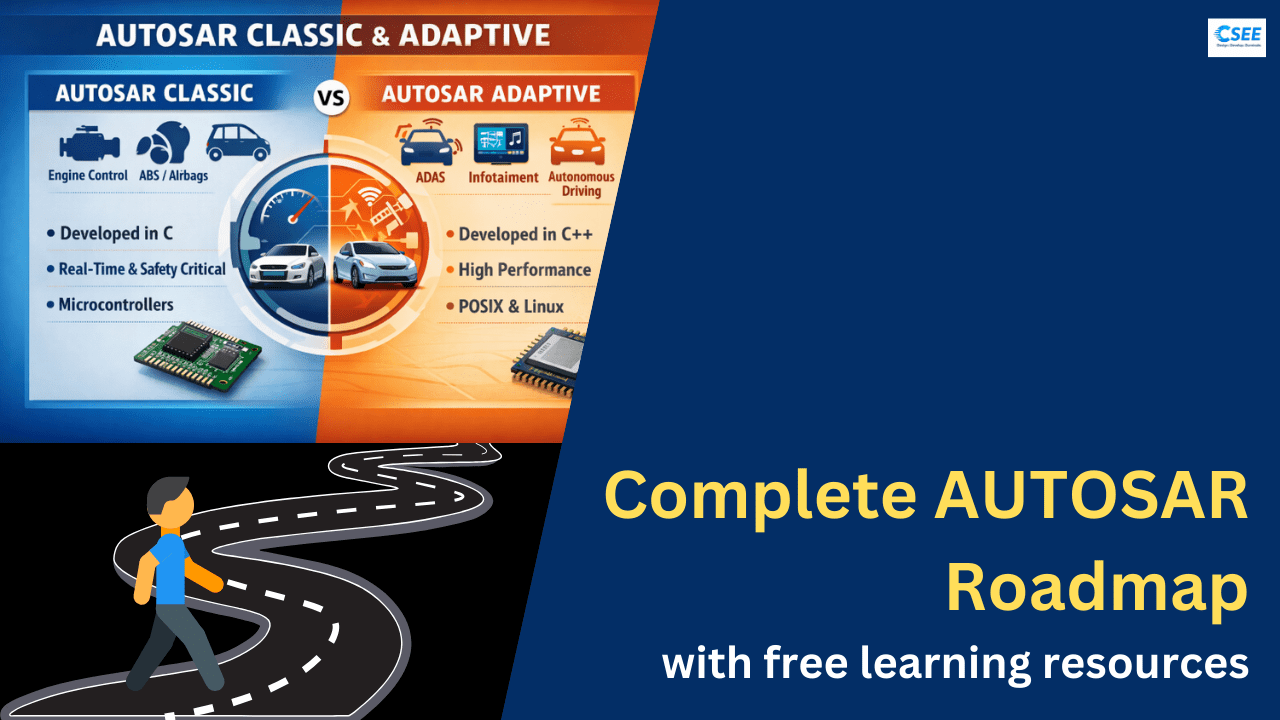
AUTOSAR has two major platforms:
1️⃣ AUTOSAR Classic Platform
- For real-time, safety-critical ECUs
- Runs on microcontrollers
- Used in:
- Engine Control
- ABS
- Airbags
- Body Control Module (BCM)
- Developed mainly in C
- Static configuration
- Deterministic behavior
2️⃣ AUTOSAR Adaptive Platform
- For high-performance computing
- Runs on MPUs / SoCs
- Used in:
- ADAS
- Autonomous Driving
- Infotainment
- OTA Updates
- Developed mainly in C++
- Dynamic, service-oriented
- POSIX OS (Linux/QNX)
📌 Roadmap Rule:
Start with Classic, then move to Adaptive
3. PREREQUISITES (VERY IMPORTANT)
Before touching AUTOSAR, you MUST be comfortable with the following.
3.1 Programming Languages
C (Mandatory)
You must know:
- Pointers
- Structures
- Memory allocation
- Bit manipulation
- Function pointers
- Static vs dynamic memory
- Volatile keyword
📘 Free Resources:
- YouTube: Neso Academy – C Programming
- YouTube: Embedded C by FastBit Embedded Brain Academy
- Book (Free PDF): The C Programming Language – K&R (searchable online)
C++ (For Adaptive AUTOSAR)
Focus on:
- OOP concepts
- RAII
- Smart pointers
- STL
- Multithreading basics
📘 Free Resources:
- YouTube: CppCon Beginner Talks
- YouTube: The Cherno – C++ Series
- Website: cplusplus.com
3.2 Embedded Systems Basics
You must understand:
- Microcontroller architecture
- Registers
- Interrupts
- Timers
- GPIO
- Communication protocols
📘 Free Resources:
- YouTube: FastBit Embedded Systems
- YouTube: Embedded Systems by MCU
- Free course PDFs from NPTEL
3.3 Automotive Communication Protocols
AUTOSAR heavily relies on:
- CAN
- LIN
- FlexRay
- Ethernet
📘 Free Resources:
- YouTube: Vector CANoe basics
- YouTube: CAN Protocol Explained – Neso Academy
- Website: css-electronics.com (free blogs)
4. AUTOSAR CLASSIC PLATFORM – COMPLETE ROADMAP
4.1 AUTOSAR Classic Architecture Overview
AUTOSAR Classic has three main layers:
1️⃣ Application Layer
- Software Components (SWC)
- Runnable entities
- Ports (Sender/Receiver, Client/Server)
2️⃣ Runtime Environment (RTE)
- Middleware
- Connects SWCs to BSW
- Auto-generated code
3️⃣ Basic Software (BSW)
Includes:
- OS
- Communication stack
- Memory services
- ECU abstraction
📌 AUTOSAR is configuration-driven, not handwritten code.
4.2 Application Layer (SWC)
Key Concepts:
- Software Components (Atomic, Composite)
- Ports and Interfaces
- Runnables
- Events
You must learn:
- Sender-Receiver Interface
- Client-Server Interface
- Mode Switch Interface
📘 Free Resources:
- YouTube: AUTOSAR Explained – Learn Automotive
- YouTube: FastBit AUTOSAR Classic Free Series
- AUTOSAR official docs (autosar.org – free PDFs)
4.3 Runtime Environment (RTE)
What RTE Does:
- Generates glue code
- Ensures communication between SWCs
- Isolates application from hardware
Learn:
- RTE APIs
- Runnable triggering
- Data access methods
📘 Free Resources:
- YouTube: RTE Explained – FastBit
- AUTOSAR Classic Specification (free reading)
4.4 AUTOSAR OS
AUTOSAR OS is based on OSEK/VDX
Learn:
- Tasks (Basic / Extended)
- ISRs (Category 1 & 2)
- Events
- Alarms
- Resources
- Scheduling
📘 Free Resources:
- YouTube: OSEK OS Explained
- FreeRTOS vs AUTOSAR OS comparison videos
- AUTOSAR OS specification PDFs
4.5 Basic Software (BSW)
Important BSW Modules to Learn:
1️⃣ ECU Abstraction Layer
- ADC
- PWM
- Dio
- Port
2️⃣ MCAL (Microcontroller Abstraction Layer)
- Direct hardware access
- Vendor-specific
3️⃣ Communication Stack
- CANIF
- CANTP
- COM
- PDU Router
4️⃣ Memory Stack
- NvM
- Fee
- Ea
📘 Free Resources:
- YouTube: BSW Explained – FastBit
- Blogs: MicrocontrollerTips
- AUTOSAR spec PDFs
4.6 Diagnostics (VERY IMPORTANT)
AUTOSAR Diagnostics uses UDS (ISO 14229)
Learn:
- DCM
- DEM
- Diagnostic Services (0x10, 0x11, 0x22, 0x31)
📘 Free Resources:
- YouTube: UDS Explained
- Blogs: CANoe Diagnostics Tutorials
- ISO UDS overview articles (free)
4.7 AUTOSAR Tools (Free & Open Source)
You should practice with:
Open-Source Tools:
- Artop (AUTOSAR Tool Platform)
- Eclipse AUTOSAR plugins
- EB Tresos trial (limited)
Simulation:
- Wokwi (for logic understanding)
- CANoe basics (free videos)
📘 Free Resources:
- Eclipse AUTOSAR GitHub
- Artop Documentation
- YouTube Tool Demo Videos
5. AUTOSAR ADAPTIVE PLATFORM – COMPLETE ROADMAP
5.1 Why Adaptive AUTOSAR?
Classic AUTOSAR cannot handle:
- Dynamic deployment
- AI workloads
- OTA updates
- High-level services
Adaptive AUTOSAR solves this.
5.2 Adaptive Architecture
Key Components:
- Adaptive Applications
- ara::com
- ara::log
- ara::exec
- Service-Oriented Architecture (SOA)
Runs on:
- Linux
- QNX
- POSIX OS
5.3 Programming for Adaptive AUTOSAR
Mandatory Skills:
- Modern C++
- Multithreading
- IPC
- Networking
- POSIX APIs
📘 Free Resources:
- YouTube: Linux System Programming
- YouTube: POSIX Threads Explained
- Book: Advanced Programming in the UNIX Environment (reference)
5.4 Service-Oriented Communication
Learn:
- Service discovery
- Event-based communication
- SOME/IP
- DDS basics
📘 Free Resources:
- YouTube: SOME/IP Explained
- Blogs: Vector Adaptive AUTOSAR Articles
5.5 Execution Management & Lifecycle
Learn:
- Process states
- Startup/shutdown handling
- Health monitoring
📘 Free Resources:
- AUTOSAR Adaptive specifications
- OEM whitepapers (free PDFs)
6. FUNCTIONAL SAFETY & AUTOSAR
AUTOSAR is closely tied to:
- ISO 26262
- ASIL levels
Learn:
- Safety goals
- Watchdogs
- Memory protection
- End-to-end protection
📘 Free Resources:
- YouTube: ISO 26262 Explained
- Blogs: Functional Safety Basics
7. REAL-WORLD PROJECT ROADMAP (FREE)
Beginner Projects:
- Simple SWC with RTE communication
- CAN message transmission
- OS task scheduling
Intermediate Projects:
- Diagnostic service implementation
- NVM read/write
- Multi-ECU communication simulation
Advanced Projects:
- Adaptive service communication
- OTA-like update simulation
- Health monitoring app
📘 Free Practice:
- GitHub AUTOSAR sample projects
- Open-source Adaptive examples
8. AUTOSAR INTERVIEW PREPARATION
Prepare for:
- Architecture questions
- BSW modules
- RTE flow
- OS scheduling
- Diagnostics
- Adaptive vs Classic
📘 Free Resources:
- YouTube: AUTOSAR Interview Questions
- GitHub: AUTOSAR Q&A Repositories
9. CAREER PATH WITH AUTOSAR
Roles:
- AUTOSAR Developer
- BSW Engineer
- ECU Software Engineer
- ADAS Software Engineer
- Platform Architect
Industries:
- OEMs
- Tier-1 Suppliers
- EV Startups
- Autonomous Vehicle Companies
10. FINAL LEARNING SEQUENCE (IMPORTANT)
Follow this exact order:
1️⃣ C Programming
2️⃣ Embedded Systems
3️⃣ Automotive Protocols
4️⃣ AUTOSAR Classic Architecture
5️⃣ AUTOSAR OS
6️⃣ BSW Modules
7️⃣ Diagnostics
8️⃣ AUTOSAR Tools
9️⃣ C++ & Linux
🔟 AUTOSAR Adaptive
FINAL WORDS
AUTOSAR is not difficult, but it is huge and structured.
If you follow this roadmap step by step, you don’t need paid courses to start.
Master the concepts → Tools become easy
Skip basics → AUTOSAR feels impossible
Thank you for reading.
Also, read:
- Which Industry Should EE & EC Students And Professionals Choose?
- EEE Career Roadmap 2026–2035 ⚡: From Core Electrical To Advanced Electronics
- ECE / EEE Core Opportunities In 2026: Complete Career Roadmap
- Complete AUTOSAR Roadmap With Free Learning Resources
- The Ultimate Roadmap To Crack Top Electronics & Semiconductor Companies (TI, Qualcomm, NVIDIA, AMD, Intel, Google, Samsung)
- How To Get Started With FPGA And Its Projects: Complete Roadmap
- The Ultimate Roadmap To Become A Part of the Software-Defined Vehicle (SDV) Revolution
- Roadmap To Become A Successful Hardware-in-the-Loop (HiL) Engineer