In an age where technology is rapidly transforming traditional industries, automotive engineering stands at the intersection of mechanics, electronics, software, data systems, and safety standards. Whether you’re a software engineer, embedded systems developer, student, researcher, or hobbyist, assembling a collection of reliable resources in this field can be overwhelming — especially when aiming to avoid costly tools, licenses, or proprietary platforms. Fortunately, the open-source community has recognized this need.
One shining example is the Awesome Automotive repository on GitHub by Marcin214 — a meticulously curated, freely available collection of high-quality automotive engineering resources. Hosted under a permissive CC0-1.0 license, this repository functions not only as a knowledge base but as a platform for community contribution and collaboration. With nearly 1000 stars and nearly 200 forks on GitHub, its visibility and usefulness across global engineering circles are evident.
This article will explore the depth and breadth of these free resources, elaborate on how they can help automotive professionals and learners, and illustrate the power of open knowledge sharing in the automotive world.
1. A New Paradigm in Automotive Resource Sharing
The automotive industry is no longer just about internal combustion engines or body design; it has evolved into a software-intensive, highly integrated systems domain. Today’s vehicles encompass complex Electronic Control Units (ECUs), advanced driver-assistance systems (ADAS), autonomous driving capabilities, and cutting-edge communication protocols — all developed through collaborative engineering efforts across software and hardware disciplines. For example, modern vehicles integrate Linux-based platforms such as Automotive Grade Linux, and standardized architectures like AUTOSAR (AUTomotive Open System ARchitecture) are shaping the future of automotive software ecosystems.
However, despite the increasing volume of automotive software and data, the industry largely maintains proprietary information, proprietary development tools, and guarded documentation. This creates barriers for new engineers, students, and even experienced professionals who want to learn, experiment, or innovate with automotive technologies without incurring high costs.
The Awesome Automotive repository aims to break down these barriers by collecting freely accessible, high-quality automotive resources in a structured way. It supports open knowledge, democratizes access to technical information, and encourages community contributions — making automotive engineering knowledge as inclusive as possible.
2. Structure of the Awesome Automotive Repository
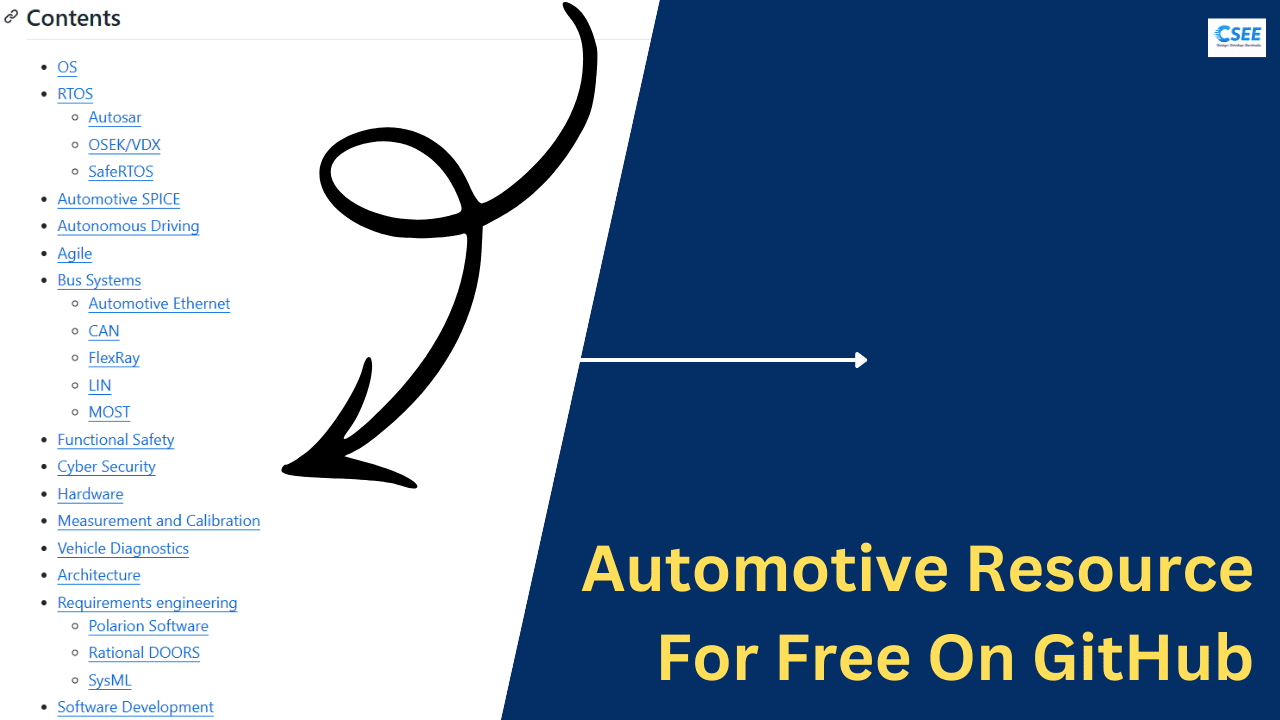
At its core, the repository organizes resources into logically grouped categories that reflect key domains within automotive engineering. These categories include:
2.1 Operating Systems (OS)
The automotive world increasingly relies on open-source operating systems, especially for in-vehicle infotainment systems, connected vehicle platforms, and embedded systems. One flagship project is Automotive Grade Linux — an open-source Linux platform designed specifically for automotive applications.
Through links and descriptions in this section, learners can:
- Understand how Linux integrates into modern vehicles.
- Find technical documents on smart car OS trends.
- Explore open-source projects that implement automotive-specific OS features.
This provides a basis for understanding how embedded systems operate under the hood of today’s connected vehicles.
2.2 Real-Time Operating Systems (RTOS)
Embedded automotive systems require predictable and reliable behavior to ensure safety and performance. This is where Real-Time Operating Systems (RTOS) play a vital role.
Within this category, the repository lists three primary subgroups:
AUTOSAR (AUTomotive Open System ARchitecture)
AUTOSAR is more than a tool — it’s an industry-wide architecture standard that enables efficient communication, modular software components, and cross-supplier compatibility in automotive ECUs. The repository links to:
- Official AUTOSAR documentation and specifications.
- Training modules and practical tools.
- Open-source frameworks and toolchains (like python modules for working with AUTOSAR XML files).
OSEK/VDX
OSEK/VDX is an older standard that served before Autosar became dominant. This section includes:
- Official OSEK technical specification documents.
- Free and licensed implementations of OSEK/VDX RTOS.
- Real-world educational examples of early automotive RTOS behavior.
SafeRTOS
This subgroup points to SafeRTOS, a functional safety-focused RTOS design, and the widely adopted ecosystem around FreeRTOS. These projects provide insight into how safety-certified real-time systems operate in embedded automotive contexts.
Overall, this section provides a valuable foundation for embedded software developers, particularly those working on safety-critical automotive subsystems.
2.3 Automotive SPICE and Agile Practices
Automotive SPICE (Software Process Improvement and Capability Determination) is a process assessment model tailored for automotive software development. This model aligns development practices with measurable capabilities — crucial for suppliers and manufacturers aiming for process maturity and quality compliance.
Likewise, agile methodologies adapted to automotive development — including scaled agile frameworks (SAFe) — are documented here with accompanying reference materials to support modern engineering workflows.
For teams transitioning to agile within safety-regulated environments, this section provides free access to best practices and critical whitepapers.
3. In-Depth Technical Domains in Automotive Engineering
The Awesome Automotive repository goes considerably deeper than surface-level links by organizing technical content in these comprehensive subcategories:
3.1 Bus Systems
Efficient in-vehicle communication protocols are foundational to complex automotive systems. This section categorizes resources into major bus technologies:
Automotive Ethernet
This subsection explores Ethernet adaptations for vehicle networking, the OPEN Alliance specifications, SOME/IP protocols, and tutorial materials explaining protocol stack architecture.
CAN (Controller Area Network)
One of the most used in-vehicle networks, CAN is explored through official specifications, tutorials, implementation guides, and educational overviews.
FlexRay
High-speed deterministic communications, especially for safety-critical systems, are covered through official standards and technical explanations.
LIN & MOST
Lower-cost and specialized automotive networking protocols like LIN (Local Interconnect Network) and MOST (Media Oriented Systems Transport) are also documented with relevant specifications and overview sources.
These resources help engineers understand how data flows within a vehicle — vital for diagnostics, functional safety, and integrated system design.
3.2 Functional Safety & Cybersecurity
Functional safety and cybersecurity represent two of the most challenging domains in automotive development.
Functional Safety
This section lists:
- ISO 26262 standards and documentation.
- Safety engineering guidelines.
- Case studies such as unintended acceleration investigations.
- Tools and verification references for safety-related systems.
Cybersecurity
As vehicles become increasingly connected, cybersecurity threats escalate proportionately. Resources in this category include:
- Cybersecurity primer documents from NHTSA.
- IEEE cybersecurity compilations.
- Research on secure control unit design.
- Lectures and symposia on automotive security topics.
Whether developing secure systems or studying threat models, engineers can use these links as free technical grounding.
3.3 Measurement & Calibration
Essential for vehicle system tuning, performance testing, and diagnostic data capture, this section points to ASAM standards like MCD-1 XCP and other calibration protocols.
These resources are crucial for understanding how automotive engineers calibrate, measure, and optimize ECUs under various conditions.
3.4 Vehicle Diagnostics
Vehicle diagnostics protocols (like UDS and DoIP) are covered here through posters, practical implementations, and academic studies. These protocols enable technicians and engineers to interface with in-vehicle systems for troubleshooting and maintenance.
4. Core Software & Development Practices
Modern automotive software teams not only rely on domain knowledge — they also depend on robust development practices and toolchains. The Awesome Automotive list addresses this with subcategories including:
4.1 Software Development & Coding Standards
This includes:
- Hands-on guides to embedded programming.
- Articles and videos from C++ conferences relevant to automotive systems.
- Books on clean coding and professional programming.
- Coding standards like MISRA C and MISRA C++ for safety-critical systems.
These free software engineering resources complement automotive domain knowledge with disciplined engineering practices.
4.2 Debugging, Testing & Static Analysis
Debugging tools (like Lauterbach Trace32) and unit testing frameworks (like Google Test) are referenced — giving engineers free access to structured tools and best practices for verifying embedded systems.
There are also extensive links to static analysis tools, timing analysis suites, and tutorials around structured testing methodologies. All of these help improve code quality and system reliability.
5. Learning Through Media: Blogs, Books, Podcasts, and Videos
Beyond technical documents and standards, the repository curates a wide array of content meant to broaden both theoretical knowledge and practical context:
- Blogs: such as automotive industry analysis, embedded systems engineering insights, and automotive wiki pages offering explanations of automotive topics.
- Books: ranging from automotive electronics fundamentals to penetration testing and embedded systems.
- Magazines: like SAE publications and vehicle electronics monthly releases.
- Podcasts: discussing electric vehicles, safety, and future transportation trends.
- Videos: webinars and educational sessions from major vendors like Vector Informatik, Elektrobit, and MATLAB showing engineering workflows.
These media resources help supplement reading and development work with narrative insights, industry trends, and expert commentary — all freely accessible.
6. Miscellaneous and Community Contributions
To support broader discovery, the list includes miscellaneous links such as:
- University publications on AUTOSAR and safety projects.
- Repository collections like Vector Knowledge Base and support archives.
- Industry supplier rankings.
- Tools for searching through other “awesome” lists across various disciplines.
This highlights how a community-driven repository can link beyond automotive to broader engineering networks.
7. How to Use This Repository Effectively
To maximize the value of this free automotive resource list, consider the following approaches:
7.1 Curate Your Learning Path
Automotive engineering is broad. Use the repository’s categories to define your focus:
- For embedded systems: start with RTOS, AUTOSAR, and bus systems.
- For functional safety roles: dive into ISO standards, verification tools, and safety case studies.
- For software engineers: pull from coding guidelines, testing frameworks, and real-world automotive video tutorials.
7.2 Apply With Projects and Hands-On Practice
Many links include downloadable materials, open-source tools, and specification documents that are perfect for building hands-on projects. Try cloning tools or using free specifications to implement sample code or simulated automotive systems.
7.3 Engage With the Community
Because the repository encourages contribution, engineers can:
- Suggest new resources.
- Create pull requests to expand sections.
- Share personal findings from industry experience.
This not only enriches the repository but helps the entire engineering community grow.
Conclusion
The Awesome Automotive repository on GitHub is more than a list of links — it is a gateway to a vast landscape of free, expertly curated automotive engineering resources. Whether your goal is to learn embedded systems, understand safety standards, explore vehicle networking protocols, or master automotive software development, this repository equips you with quality resources without restrictive paywalls or licensing fees.
Open knowledge democratizes innovation. In the fast-paced world of automotive technology — where vehicles are becoming autonomous, connected, and software-driven — having free access to reliable learning and development tools is not just valuable — it’s essential.
Free Resources: https://github.com/Marcin214/awesome-automotive
Thank you for reading.
Also, read:
- India’s GaN Chip Breakthrough: Why Gallium Nitride Could Shape the Future of Defense Electronics
- India’s Chip Era Begins: A New Chapter in Semiconductor Manufacturing
- FlexRay Protocol – Deep Visual Technical Guide
- Top 50 AI-Based Projects for Electronics Engineers
- India AI Impact Summit 2026: The Shift from AI Hype to AI Utility
- Python Isn’t Running Your AI — C++ and CUDA Are!
- UDS (Unified Diagnostic Services) — Deep Visual Technical Guide
- Automotive Ethernet — Deep Visual Technical Guide