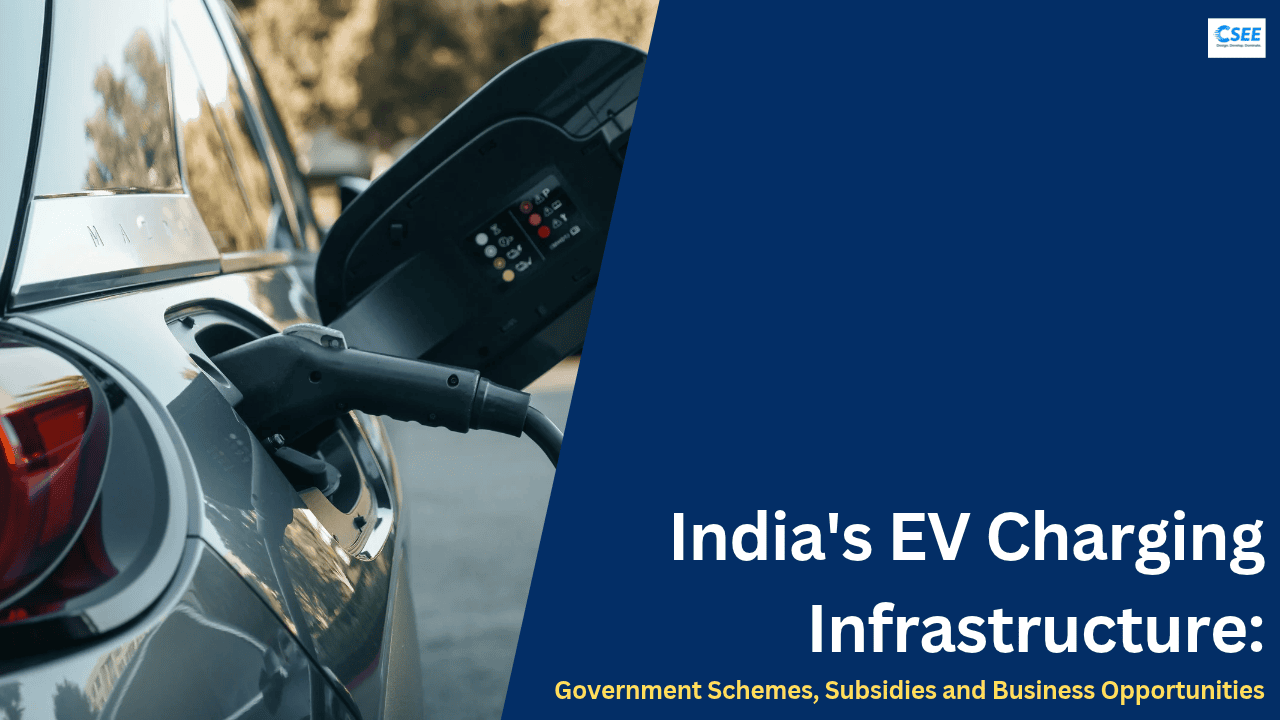
India is rapidly moving towards electric mobility. Electric vehicles (EVs) are becoming increasingly popular because of rising petrol and diesel prices, growing environmental concerns, technological advancements and government support. From electric scooters and three-wheelers to electric cars, buses and commercial trucks, almost every segment of the automobile industry is gradually adopting electric technology.
However, there is one major challenge that could slow down India’s EV revolution: charging infrastructure. Imagine purchasing an electric car but struggling to find a charging station during a highway journey. Or imagine owning an electric scooter but living in an apartment where installing a personal charger is difficult. These are some of the challenges that EV users face today.
1. Introduction: India’s Electric Vehicle Revolution
India needs not only more electric vehicles but also a reliable, accessible and affordable charging network. The opportunity is enormous because the EV industry is not limited to vehicle manufacturing. It also includes battery manufacturing, power electronics, charging equipment, software platforms, electricity distribution, energy storage and charging station operations.
According to NITI Aayog, more than 87 lakh electric vehicles were on Indian roads by FY 2025-26, and EV adoption had reached approximately 8.25% of new vehicle registrations. Around 25 lakh EVs were registered during that financial year alone. This shows how quickly the market is expanding. NITI Aayog+1
The big question is whether India’s charging infrastructure is growing fast enough to support this expansion. More importantly, can entrepreneurs and startups build profitable businesses by solving this infrastructure gap?
2. How Many Electric Vehicles Are There in India?
India has witnessed significant growth in electric vehicle registrations over the last few years. Unlike traditional automobiles, electric vehicles are particularly popular in the two-wheeler and three-wheeler segments.
Electric two-wheelers are increasingly used for daily commuting because they are relatively affordable and have lower running costs. Electric three-wheelers, including e-rickshaws and passenger autos, are becoming important for last-mile transportation. Electric cars are gaining popularity in metropolitan cities, while electric buses and commercial vehicles are creating opportunities in public transportation and logistics.
The EV market can broadly be divided into five categories: electric two-wheelers, electric three-wheelers, electric passenger cars, electric buses and electric commercial vehicles.
Each category has different charging requirements. An electric scooter owner may charge the vehicle at home overnight, whereas an electric taxi may require fast charging several times a day. Electric buses may need dedicated high-capacity charging systems at depots.
Therefore, India cannot depend on one type of charging infrastructure. It needs a combination of residential chargers, public AC chargers, DC fast chargers, highway charging hubs and battery-swapping facilities.
3. How Many EV Charging Stations Are Available in India?
According to the Ministry of Heavy Industries, India had approximately 52,718 public EV charging stations as of July 2026. Out of these, 16,561 public charging stations were equipped with fast chargers for electric cars. Press Information Bureau
This is a significant improvement compared with previous years. However, the total number of charging stations does not tell us everything about the quality of the infrastructure.
For example, imagine a charging hub containing four DC fast chargers and four AC charging points. It is one physical charging location, but it offers eight individual charging points.
Similarly, a charging station may be installed but not operational because of electrical problems, maintenance issues or equipment failure.
Therefore, India must focus on three important factors: the number of charging locations, the number of operational charging points and the actual charging capacity available to customers.
Another important consideration is geographical distribution. A city may have hundreds of charging stations, while a smaller town or highway route may have very few.
The objective should be to develop a charging network that is accessible to EV owners wherever they travel.
4. How Many Charging Stations Does India Actually Need?
There is no single universally applicable number because charging requirements depend on EV adoption, vehicle categories, battery capacity, daily driving distance and charging behaviour.
However, an estimate frequently discussed in India’s EV infrastructure planning is approximately 13.2 lakh public charging stations by 2030. This is an industry infrastructure estimate, not a formally notified government target. The Financial Express
If India wants to support millions of electric vehicles, charging infrastructure must expand considerably.
Consider the different requirements.
Residential charging is important because most private electric vehicle owners prefer charging their vehicles overnight. Apartment complexes, residential societies, independent houses and office parking areas will need suitable electrical connections and charging facilities.
Public charging infrastructure is necessary for people who cannot charge their vehicles at home. It is also essential for electric taxis, delivery vehicles, commercial fleets and intercity travellers.
Highway charging infrastructure is another major requirement. Fast-charging stations should be developed along major highways, expressways, industrial corridors and tourist routes. These facilities should provide convenient charging opportunities during long-distance journeys.
Commercial fleets will require dedicated charging depots because their vehicles operate for several hours every day. Electric buses, delivery vans and taxis need reliable charging systems to avoid operational delays.
The important point is that India should not simply increase the number of charging stations. It should build the right charging infrastructure in the right locations.
5. Is There a Gap in India’s EV Charging Infrastructure?
Yes, there is a significant infrastructure development opportunity. However, the gap is not simply about the total number of charging stations. It is also about accessibility, charging speed, reliability and geographical distribution.
One major challenge is the uneven distribution of charging stations. Metropolitan cities generally have better charging infrastructure compared with smaller cities and rural regions. EV users travelling between smaller towns may struggle to find reliable charging facilities.
Another challenge is highway charging. Electric vehicles are becoming increasingly capable of long-distance travel, but highway charging infrastructure must expand alongside vehicle adoption. Charging facilities need to be available at petrol pumps, restaurants, hotels, highway rest areas and commercial parking locations.
Charging speed is equally important. Conventional AC chargers may take several hours to charge an electric vehicle, depending on its battery capacity and charging capability. DC fast chargers can reduce charging time significantly, but they are more expensive and require higher electrical capacity.
Electricity infrastructure is another challenge. Installing a high-capacity EV charger is not as simple as purchasing the equipment and connecting it to an electrical socket. Large charging stations may require distribution transformers, high-voltage cables, circuit breakers, electrical protection systems and grid upgrades.
Charger reliability is also a concern. Imagine reaching a charging station during a long journey and discovering that the charger is not working. This creates inconvenience and reduces consumer confidence.
Finally, there is the question of profitability. Charging stations require investment in land, equipment, electricity connections and maintenance. However, revenue depends on the number of vehicles using the facility. A charging station in a low-traffic location may take considerably longer to recover its investment.
These challenges create opportunities for businesses that can provide reliable, affordable and scalable solutions.
6. Government Schemes Supporting EV Charging Infrastructure in India
The Indian government has introduced several schemes and policies to encourage electric vehicle adoption, battery manufacturing and charging infrastructure development. Some schemes directly support charging infrastructure, while others strengthen the larger EV ecosystem.
PM E-DRIVE Scheme
The PM Electric Drive Revolution in Innovative Vehicle Enhancement Scheme, commonly known as PM E-DRIVE, is one of India’s major initiatives to accelerate electric mobility.
It was launched in September 2024 with an original financial outlay of ₹10,900 crore. The scheme’s total outlay was subsequently increased to ₹11,900 crore in August 2026, and its implementation period was extended to March 2028 for most supported segments. PM E-DRIVE+1
The scheme supports electric two-wheelers, three-wheelers, buses, trucks, ambulances and public charging infrastructure.
One of its most important components is the allocation of ₹2,000 crore for public EV charging infrastructure.
The government provides capital subsidies for eligible charging infrastructure based on the location category.
For government premises, Category A, the scheme provides 100% support for eligible upstream electrical infrastructure and charging equipment. For Category B locations, such as government-controlled public parking areas, railway stations, metro stations and selected highway facilities, it provides 80% support for upstream infrastructure and 70% for charging equipment.
For Category C locations, including shopping malls, market complexes and other eligible commercial locations, the scheme provides 80% support for upstream infrastructure. Category D covers battery-swapping and battery-charging stations, with 80% support for eligible upstream infrastructure. Press Information Bureau+1
Upstream infrastructure includes transformers, electrical cables, distribution boxes, circuit breakers and other electrical systems required to operate charging stations.
An important point is that these subsidies are not automatically available to every private individual or charging station owner. Eligible government ministries, central public-sector enterprises, state governments and their public-sector entities submit proposals through designated nodal agencies. Private charging operators can participate in projects through partnerships and tenders.
This creates an opportunity for private companies to install, operate and maintain charging stations under government-supported projects.
FAME India Scheme – Phase II
FAME stands for Faster Adoption and Manufacturing of Hybrid and Electric Vehicles in India.
FAME-II was implemented between April 2019 and March 2024 with a total budgetary support of ₹11,500 crore.
The scheme supported electric vehicle adoption through purchase incentives and grants for charging infrastructure. It covered electric two-wheelers, three-wheelers, four-wheelers and electric buses.
The government allocated ₹912.50 crore for public EV charging infrastructure under FAME-II. It also supported the deployment of electric buses and helped accelerate EV adoption across the country.
Although FAME-II has ended, the charging stations and other infrastructure developed under the scheme continue to support India’s EV ecosystem. Press Information Bureau+1
PLI Scheme for Advanced Chemistry Cell Battery Manufacturing
PLI stands for Production Linked Incentive.
The government introduced the PLI scheme for Advanced Chemistry Cell battery storage with a financial outlay of ₹18,100 crore.
The objective is to develop domestic battery manufacturing capabilities and reduce India’s dependence on imported battery technologies.
The programme aims to establish 50 GWh of advanced battery manufacturing capacity.
Why is this important for EV charging?
Battery technology directly affects charging speed, battery capacity, energy density, charging efficiency and vehicle range.
As domestic battery manufacturing expands, India can develop a stronger EV supply chain. It can also create opportunities for battery-swapping businesses, energy storage companies and charging equipment manufacturers. Press Information Bureau
PLI Scheme for Automobile and Auto Components
The government introduced the PLI scheme for the automobile and auto-component industry with a budgetary outlay of ₹25,938 crore.
It aims to promote domestic manufacturing of advanced automotive technologies, including EV-related components and systems.
Potential areas include electric powertrains, automotive electronics, power electronics, advanced vehicle components and other eligible automotive technologies.
This scheme is particularly relevant for manufacturers developing EV-related electronics and components.
State Government EV Policies
Apart from central government schemes, several Indian states have introduced their own EV policies.
States such as Maharashtra, Karnataka, Delhi, Tamil Nadu, Gujarat and Telangana have introduced policies to encourage EV adoption and infrastructure development.
Depending on the state and applicable policy, businesses may receive support through capital subsidies, land or lease concessions, electricity tariff incentives and other infrastructure-related benefits.
However, incentives differ significantly by state, policy period and applicant eligibility. Entrepreneurs should check the latest state policy before investing.
GST Benefits
The government has reduced GST on electric vehicles and EV chargers or charging stations to 5%.
This helps reduce the tax burden associated with EV adoption and charging equipment and supports the development of the electric mobility ecosystem. Press Information Bureau
Ministry of Power EV Charging Guidelines
The Ministry of Power issued the Guidelines for Installation and Operation of Electric Vehicle Charging Infrastructure in September 2024.
One important aspect is that setting up EV charging stations is an unlicensed activity. This means private entrepreneurs can establish charging stations without obtaining a separate electricity distribution licence, subject to applicable technical, electrical safety and regulatory requirements.
The guidelines also address charging standards, interoperability, electricity supply, battery-swapping infrastructure and charging station operations.
This makes it easier for private businesses to enter the charging infrastructure market. Press Information Bureau+1
7. EV Charging Business Opportunities in India
Now comes the most interesting part. India’s EV charging infrastructure gap is not just a challenge for the government. It is also a significant business opportunity.
Entrepreneurs, startups, engineering companies, real estate developers and investors can participate in this growing industry.
There are several business models worth exploring.
1. Setting Up Public EV Charging Stations
One of the most straightforward opportunities is establishing public EV charging stations.
You can purchase EV charging equipment, arrange a suitable electricity connection and establish a charging facility at a commercial location.
Potential locations include shopping malls, petrol pumps, hotels, restaurants, commercial parking spaces, office complexes and highways.
Revenue can be generated by charging customers based on electricity consumption or applicable service fees. You can also partner with existing charging network operators to manage payments, customer access and station operations.
However, profitability depends on electricity tariffs, charger utilisation, rent, equipment costs and maintenance.
2. Highway Fast-Charging Networks
Highway charging is another major business opportunity because electric vehicle owners need reliable charging facilities during long-distance journeys.
Imagine establishing a charging hub along a busy highway with multiple DC fast chargers, restaurants, restrooms, parking facilities and convenience stores.
Such charging hubs can generate revenue through charging services and additional facilities.
The ideal locations would be highways connecting major cities, industrial corridors, tourist destinations and expressways.
However, selecting locations based on actual EV traffic and electricity availability is extremely important.
3. EV Charging Software and Management Platforms
This is particularly interesting for software developers and technology startups.
Imagine developing a platform that allows charging station operators to monitor all their chargers through one dashboard.
The software could provide real-time charger status, customer authentication, digital payments, charging session management, electricity consumption monitoring, remote diagnostics, maintenance alerts and revenue analytics.
You could also develop a mobile application that helps EV owners locate nearby charging stations, check availability, compare prices and make payments.
Charging operators could pay a monthly subscription for using the platform.
This business model is attractive because software can be scaled across multiple charging locations without owning every physical charging station.
4. Battery Swapping Stations
Battery swapping is another promising business opportunity, especially for electric two-wheelers and three-wheelers.
Instead of waiting for the battery to charge, customers visit a swapping station and exchange their discharged battery for a fully charged one.
The process can take only a few minutes, depending on the system.
This model is particularly useful for delivery executives, electric auto-rickshaw drivers, logistics companies and commercial two-wheeler users.
The business can generate revenue through battery subscriptions, swapping fees and fleet contracts.
However, battery compatibility, safety, standardisation and battery inventory management remain important challenges.
5. Charging Infrastructure for Apartment Complexes
As more people purchase electric cars, residential societies will need dedicated charging facilities.
You can work with apartment associations and real estate developers to install EV charging infrastructure.
For example, you could provide individual chargers for residents, shared charging stations, electricity billing systems, smart load management and annual maintenance services.
This is particularly relevant in metropolitan cities such as Mumbai, Pune, Bengaluru, Hyderabad and Delhi, where apartment living is common.
6. Fleet Charging Solutions
Electric fleet operators need reliable charging infrastructure because their vehicles operate for several hours every day.
You can establish dedicated charging facilities for electric taxis, delivery companies, logistics operators, corporate transportation services and electric buses.
Instead of depending entirely on individual customer transactions, you can sign long-term contracts with fleet operators.
This can provide more predictable revenue if vehicle utilisation and contract terms are favourable.
7. Solar-Powered EV Charging Stations
Solar-powered EV charging stations combine renewable energy and electric mobility.
You can install solar panels on the roof of a charging station or parking area. The generated electricity can be used to charge electric vehicles, reducing dependence on grid electricity.
A battery energy storage system can also be integrated to store excess solar energy and provide electricity when required.
Potential customers include hotels, shopping malls, corporate campuses, residential communities and highway charging operators.
The business opportunity is not just selling electricity. It is providing integrated energy management solutions.
8. EV Charger Manufacturing
India also needs domestic manufacturers of EV charging equipment.
Companies can develop and manufacture AC chargers, DC fast chargers, power conversion modules, charging connectors, cables, control electronics, communication modules and electrical protection systems.
EV chargers require power electronics, microcontrollers, communication protocols, thermal management and electrical protection systems.
This creates an opportunity for electronics, electrical and embedded systems engineers to develop innovative charging products.
For example, startups can work on efficient power conversion systems, charger controllers, smart communication modules and remote monitoring solutions.
9. EV Charging Maintenance and Installation Services
Another opportunity is providing installation, maintenance and repair services.
As charging infrastructure expands, charging operators will require technicians and engineering companies to maintain their equipment.
Businesses can offer electrical installation, charger commissioning, preventive maintenance, fault diagnosis, software updates and equipment replacement.
This is a potentially interesting business because charging stations require regular maintenance throughout their operational life.
8. How Much Investment Is Required to Start an EV Charging Business?
Investment depends on the type of charger, location, electricity connection, land requirements and installation complexity.
For example, installing a small AC charging setup at an existing commercial property will generally require less investment than developing a highway charging hub with multiple high-capacity DC fast chargers.
A charging station’s total project cost may include:
- Charging equipment and installation.
- Electrical connection and transformer upgrades.
- Land purchase or rental.
- Civil construction and parking arrangements.
- Software and payment integration.
- Safety equipment and electrical protection.
- Maintenance and operational expenses.
Entrepreneurs should obtain quotations from charger manufacturers, electrical contractors and electricity distribution companies before preparing a financial plan.
The most important thing is not to invest in expensive chargers before validating local demand.
A small pilot charging station in a high-demand location may be a better starting point than immediately establishing a large charging network.
9. How Can You Start an EV Charging Business in India?
If you are planning to enter this industry, start by identifying your target customers. Decide whether you want to serve electric cars, two-wheelers, three-wheelers, taxis or commercial fleets.
Next, select a suitable location. Study EV traffic, parking availability, nearby charging facilities and electricity infrastructure. A location with high EV traffic and convenient access is generally more attractive.
Conduct a feasibility study to estimate the expected number of daily charging sessions, electricity consumption, operating costs and potential revenue.
Once the location is finalised, choose charging equipment according to the vehicle segment and relevant Indian standards. Coordinate with your local electricity distribution company for the required connection and electrical load.
You should also develop suitable software and payment facilities so customers can locate chargers, check availability, initiate charging and make payments digitally.
Finally, explore government-supported projects, state EV policies, public-sector tenders and partnerships with existing charge-point operators.
Remember that installing a charger is only the beginning. Maintaining equipment reliability, providing customer support and ensuring transparent billing are equally important.
10. Challenges EV Charging Startups Must Solve
Although this market has significant potential, entrepreneurs should understand the risks before investing.
The biggest challenge is high initial capital expenditure. Setting up a charging station requires investment in equipment, electricity connections, installation and sometimes expensive grid upgrades.
Another challenge is charger utilisation. A charging station may receive very few customers during its initial months, making it difficult to recover the investment.
Land availability and rental costs can also affect profitability, especially in metropolitan cities.
Technology compatibility is another concern because different electric vehicles may support different charging connectors, power ratings and communication protocols.
Businesses must also consider charger maintenance, electricity tariffs, competition and changing battery technologies.
One common mistake is assuming that every EV charging station will automatically become profitable. A charging station can have expensive equipment but generate very little revenue if it is located in an area with low EV traffic.
Therefore, demand analysis is more important than simply installing more chargers.
11. What Does the Future of EV Charging Look Like in India?
India’s EV charging ecosystem is likely to evolve significantly over the coming years. Several emerging technologies could shape the next phase of development.
Ultra-fast charging systems will become increasingly important for electric cars, buses and commercial vehicles. Higher-power DC charging can reduce waiting times, provided the vehicle supports the required charging capacity.
Smart charging will allow charging stations to communicate with the electricity grid and optimise charging schedules based on demand, electricity prices and available power.
Vehicle-to-Grid technology, commonly known as V2G, could allow compatible electric vehicles to send electricity back to the grid. This may help manage electricity demand and support grid stability in the future.
Battery energy storage systems could also become important. Charging stations may integrate stationary batteries to reduce peak electricity demand and support high-power charging without requiring equally high grid capacity at every moment.
Artificial intelligence can help predict charging demand, optimise electricity usage, identify equipment failures and improve charging station utilisation.
Renewable energy integration is another important opportunity. Solar-powered charging stations combined with battery storage could help reduce dependence on conventional electricity sources.
These developments create opportunities not only for automobile companies but also for semiconductor manufacturers, embedded systems engineers, software developers, battery companies and energy startups.
12. Conclusion: India’s EV Charging Gap Is a Business Opportunity
India’s electric mobility revolution is already underway, but the next major challenge is building the infrastructure required to support it.
The country has millions of electric vehicles on its roads, and public charging infrastructure is expanding. However, more work is required in highway charging, fast-charging networks, residential charging, battery swapping and commercial fleet infrastructure.
Government initiatives such as PM E-DRIVE, FAME-II, PLI for Advanced Chemistry Cells and state EV policies are helping develop the ecosystem.
At the same time, private companies and startups have opportunities to build charging networks, manufacture charging equipment, develop software platforms and provide integrated energy solutions.
The biggest opportunity may not necessarily be manufacturing electric vehicles. It could be building the infrastructure and technology that make electric mobility practical for millions of Indians.
India’s EV future will depend not only on how many electric vehicles we manufacture but also on how easily people can charge them.
13. Important Government Schemes at a Glance
Here is a quick summary of the major government initiatives discussed in this article:
| Government scheme or initiative | Main objective |
|---|---|
| PM E-DRIVE | EV adoption and ₹2,000 crore allocation for charging infrastructure |
| FAME-II | EV purchase incentives and public charging infrastructure |
| PLI-ACC | ₹18,100 crore support for advanced battery manufacturing |
| PLI-Auto | ₹25,938 crore support for advanced automotive technology |
| State EV Policies | State-specific EV and infrastructure incentives |
| GST reduction | 5% GST on EVs and EV charging equipment |
| Ministry of Power Guidelines | Framework for establishing and operating charging stations |
These schemes have different eligibility conditions. In particular, PM E-DRIVE charging infrastructure subsidies are routed through eligible government and public-sector nodal agencies rather than being an unrestricted direct subsidy for every private charging station owner.
14. Frequently Asked Questions
Can an individual start an EV charging station in India?
Yes. Setting up EV charging stations is an unlicensed activity under the applicable government framework. Private entrepreneurs can establish charging stations while following electrical safety, technical and regulatory requirements.
Does the government provide subsidies for EV charging stations?
Yes. PM E-DRIVE provides financial support for eligible public charging infrastructure. However, private businesses generally need to participate through eligible nodal agencies, government projects or partnerships.
Is an electricity distribution licence required?
A separate electricity distribution licence is not required to establish an EV charging station. However, the operator must comply with applicable electricity supply, technical and safety requirements.
Which EV charging business is best for beginners?
A small charging setup at an existing commercial property, apartment complex or fleet depot may be a practical starting point. The best option depends on local EV demand and investment capacity.
Can software engineers build businesses in the EV charging industry?
Absolutely. Charging management software, smart energy management, charger communication systems, payment platforms, remote diagnostics and AI-based maintenance are promising opportunities.
Is EV charging a profitable business?
It can be profitable, but success depends on charger utilisation, electricity costs, land rent, equipment costs, maintenance and customer demand. Location selection is critical.
Final Thoughts
India’s EV charging infrastructure is still developing, and there is significant room for innovation across the entire ecosystem.
Whether you are an entrepreneur, investor, software developer, electrical engineer or startup founder, this industry offers several opportunities.
The next big Indian EV startup may not manufacture a vehicle. It could build the charging network that powers millions of vehicles.