Engineering careers are no longer built only on degrees. In 2026, internships are the real differentiator. Recruiters, research organizations, startups, and global tech giants are all asking one question before hiring: What real-world problems have you worked on?
Whether you are from EEE, ECE, Mechanical, Civil, Computer Science, Aerospace, or interdisciplinary branches, your internship experience can decide:
- Which companies shortlist your resume
- Whether you get core engineering roles or get pushed into unrelated jobs
- Your chances of entering research, space, defense, or global tech organizations
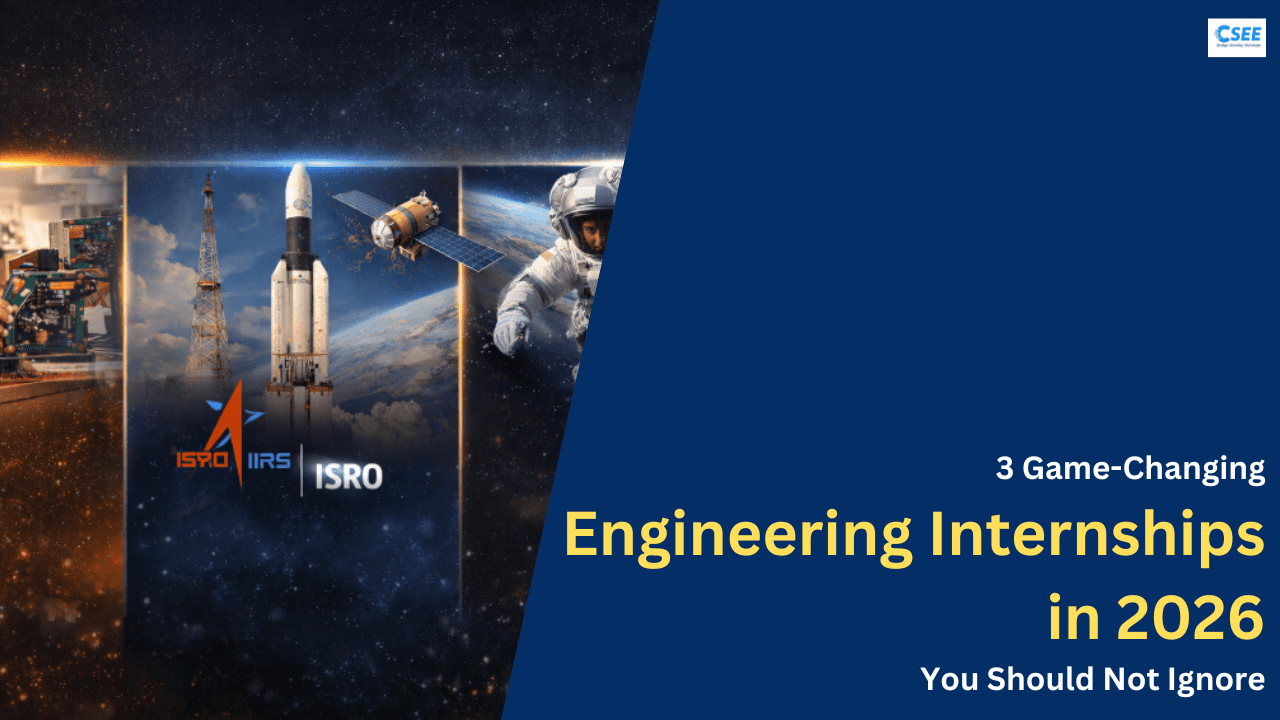
Among hundreds of internships advertised every year, only a few truly change your career trajectory. In 2026, three internships clearly stand out for their scale, credibility, learning depth, and long-term impact:
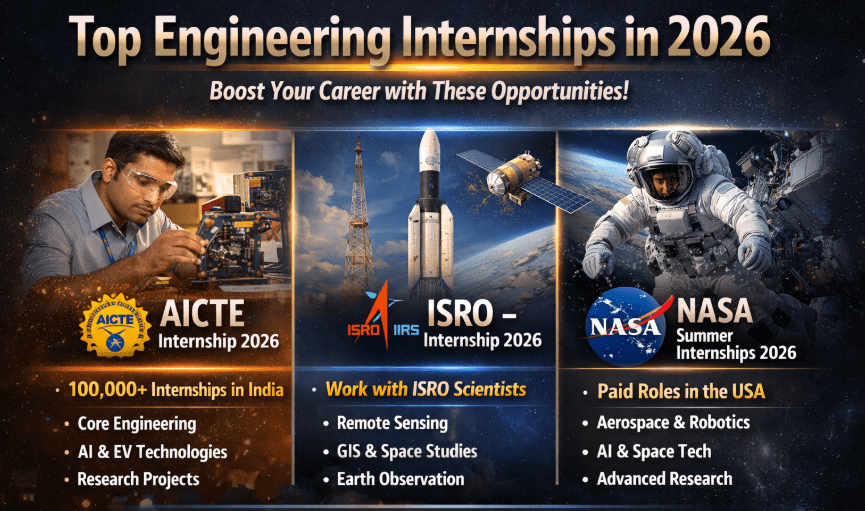
- AICTE Internship 2026 (India’s largest structured internship ecosystem)
- ISRO – IIRS External Student Internship 2026 (Direct exposure to space applications)
- NASA Summer 2026 Internships (Global, paid, elite research & engineering exposure)
This article explains each internship in deep detail, covering:
- What the program is
- Who can apply
- Domains and technologies involved
- What you actually learn
- Career impact
- Why it matters in 2026
- Key benefits and limitations
If you are serious about engineering, this article is your roadmap.
Part 1: AICTE Internship 2026 – India’s Biggest Opportunity for Engineering Students
1. What Is AICTE Internship 2026?
The AICTE Internship Program 2026 is a national-level initiative by the All India Council for Technical Education (AICTE) aimed at bridging the gap between academic learning and industry requirements.
Unlike traditional internships that depend on personal references or college tie-ups, this program:
- Centralizes internships on a government-backed platform
- Connects students directly with industries, startups, PSUs, MSMEs, and research organizations
- Ensures internships align with engineering disciplines and emerging technologies
In 2026, AICTE has expanded the program significantly, making it one of the largest internship ecosystems in the world.
2. Scale and Reach of AICTE Internship 2026
AICTE Internship 2026 is not a small initiative. It operates at national scale.
Key highlights:
- 100,000+ internship opportunities
- Open to students from AICTE-approved institutions
- Covers technical, research, core engineering, and interdisciplinary roles
- Includes paid, unpaid, virtual, hybrid, and on-site internships
This scale ensures that students from Tier-1, Tier-2, and Tier-3 colleges get equal access.
3. Who Can Apply for AICTE Internship 2026?
AICTE Internship 2026 is designed to be inclusive.
Eligible candidates include:
- Diploma students (technical branches)
- B.Tech / BE students (all engineering streams)
- M.Tech / ME students
- Integrated degree students
- Final-year as well as pre-final-year students
There is no restriction to IT-only branches. Core engineering students benefit equally.
4. Engineering Domains Covered
One of the strongest advantages of the AICTE Internship is its wide domain coverage.
Major domains include:
- Electrical Engineering (Power systems, EVs, smart grids)
- Electronics & Communication (Embedded systems, VLSI basics, IoT)
- Mechanical Engineering (Design, manufacturing, automation)
- Civil Engineering (Smart infrastructure, sustainability, planning)
- Computer Science & IT (AI, ML, cloud, cybersecurity)
- Artificial Intelligence & Data Science
- Internet of Things (IoT)
- Electric Vehicles and Renewable Energy
- Robotics and Automation
- Semiconductor fundamentals
- Industry 4.0 and smart manufacturing
This makes it future-oriented, not limited to outdated skills.
5. Nature of Work in AICTE Internship 2026
Unlike dummy internships, many AICTE-listed internships involve real deliverables.
Students may work on:
- Live industry projects
- Product development tasks
- Research and data analysis
- Simulation and modeling
- Field surveys and technical documentation
- Software and hardware integration
- Testing, validation, and reporting
The complexity of work depends on:
- Internship provider
- Duration (4 weeks to 6 months)
- Student’s academic level
6. Paid vs Unpaid Internships
AICTE Internship 2026 includes both paid and unpaid opportunities.
Paid internships:
- Monthly stipend (varies by organization)
- Mostly offered by startups, MSMEs, and corporates
- Performance-based extensions possible
Unpaid internships:
- Focus on learning and certification
- Useful for early-year students
- Often research or academic-oriented
Both types are AICTE-verified, which adds credibility.
7. Learning Outcomes and Skill Development
Students completing AICTE internships typically gain:
- Practical exposure to engineering tools
- Industry-relevant problem-solving skills
- Understanding of workflows used in real companies
- Team collaboration experience
- Technical documentation and reporting skills
These outcomes directly improve employability.
8. Career Impact of AICTE Internship
AICTE Internship experience helps students:
- Strengthen resumes with verified experience
- Perform better in campus placements
- Get referrals for full-time roles
- Transition smoothly from college to industry
- Explore domains before committing to a career path
For many students, this internship becomes their first professional exposure.
9. Limitations to Be Aware Of
While powerful, AICTE Internship 2026 has some limitations:
- Quality varies depending on provider
- Some internships may be more observational
- Competition for top roles can be high
However, with careful selection, it remains highly valuable.
10. Why AICTE Internship 2026 Matters in 2026
In 2026:
- Companies demand experience over marks
- Core engineering jobs require hands-on exposure
- Students must differentiate themselves early
AICTE Internship provides structured access to industry at scale, making it a must-consider program.
Link: https://internship.aicte-india.org/
Part 2: ISRO – IIRS External Student Internship 2026
1. What Is ISRO – IIRS External Student Internship?
The ISRO – IIRS External Student Internship is offered by the Indian Institute of Remote Sensing (IIRS), a premier research and training center under ISRO.
This internship allows students to work on space-based applications, not rocket launches, but the technology that uses satellite data to solve real-world problems.
2. Why IIRS Is Special
IIRS is a center of excellence in:
- Remote sensing
- Geospatial technology
- Satellite data analysis
- Earth observation
Students don’t just learn theory—they apply space technology to real problems.
3. Who Can Apply?
Eligible students include:
- Engineering students (EEE, ECE, Civil, Mechanical, CSE)
- Science students (Physics, Geography, Environmental Science)
- UG, PG, and doctoral students
Students must show academic seriousness and interest in geospatial domains.
4. Core Domains Covered
ISRO – IIRS Internship focuses on:
- Remote sensing
- GIS (Geographic Information Systems)
- Satellite image processing
- Climate and environmental studies
- Urban planning and smart cities
- Disaster management
- Agriculture and water resource management
This makes it highly interdisciplinary.
5. Technologies and Tools Used
Interns may work with:
- Satellite imagery datasets
- GIS software
- Remote sensing platforms
- Data interpretation techniques
- Research methodologies
These tools are used globally in space agencies, environmental firms, and government bodies.
6. Nature of Work
Students typically:
- Work under ISRO scientists
- Analyze satellite data
- Prepare technical reports
- Participate in research discussions
- Learn structured scientific workflows
This is research-intensive, not corporate-style.
7. Learning Outcomes
Key skills gained:
- Scientific thinking
- Data-driven analysis
- Understanding Earth systems
- Research documentation
- Exposure to national-level projects
These skills are rare among typical engineering graduates.
8. Career Impact
ISRO internship experience:
- Strongly boosts profiles for higher studies
- Helps in research roles and PhD admissions
- Adds credibility for space, defense, and climate-tech careers
- Signals seriousness and discipline
Many interns later pursue:
- M.Tech / MS / PhD
- Research roles
- Government technical positions
9. Challenges
- Highly competitive selection
- Requires academic focus
- Less suitable for purely corporate IT roles
But for research- or space-inclined students, it is gold.
10. Why ISRO – IIRS Internship Matters in 2026
In 2026:
- Climate change, sustainability, and smart cities are global priorities
- Space data is critical for decision-making
- Engineers with geospatial skills are in demand
This internship places students at the intersection of space and society.
Link: https://www.iirs.gov.in/content/external-student-internship
Part 3: NASA Summer 2026 Internships
1. What Are NASA Summer Internships?
NASA Summer Internships are paid, highly selective programs offered by NASA (USA) for students worldwide.
Interns work on real NASA missions, research, and advanced engineering projects.
2. Global Prestige of NASA Internships
NASA internships are considered:
- Elite
- Globally recognized
- Extremely competitive
Having NASA on your resume is a career-defining milestone.
3. Who Can Apply?
Eligible candidates:
- Undergraduate and postgraduate students
- Engineering, science, and technology backgrounds
- Strong academic and technical profiles
International students can apply to selected programs.
4. Engineering Domains at NASA
NASA internships cover:
- Aerospace engineering
- Robotics
- Artificial intelligence
- Autonomous systems
- Materials science
- Electrical and electronics engineering
- Software and systems engineering
This is cutting-edge engineering.
5. Nature of Work
Interns:
- Work with NASA scientists and engineers
- Contribute to ongoing missions
- Participate in research and development
- Use advanced labs and simulation tools
This is real engineering, not observation.
6. Paid Internship Advantage
NASA internships are:
- Paid
- Structured
- Time-bound (summer duration)
This makes them accessible and professional.
7. Skills Gained
NASA interns gain:
- Advanced technical skills
- Research methodologies
- Team collaboration in global environments
- Exposure to mission-critical systems
These skills are transferable worldwide.
8. Career Impact
NASA internship alumni often:
- Get into top universities
- Join global tech companies
- Enter aerospace and defense industries
- Build research-oriented careers
The brand value is unmatched.
9. Challenges
- Extremely competitive
- Requires strong fundamentals
- Application process is rigorous
But the reward justifies the effort.
10. Why NASA Internships Matter in 2026
In 2026:
- Space technology is accelerating
- AI + aerospace is booming
- Global collaboration is key
NASA internships place students at the frontier of innovation.
Link: https://www.nasa.gov/learning-resources/internship-programs/
Final Comparison: Which Internship Should You Choose?
Choose AICTE Internship 2026 if:
- You want industry exposure in India
- You are early in your engineering journey
- You want scalable opportunities
Choose ISRO – IIRS Internship if:
- You are interested in space applications
- You like research and analysis
- You aim for higher studies or government research roles
Choose the NASA Internship if:
- You aim global
- You want elite research exposure
- You are ready for intense competition
Conclusion: One Comment Can Change Your Career
These three internships are not ordinary opportunities. They represent:
- Scale (AICTE)
- Scientific depth (ISRO)
- Global excellence (NASA)
If you are serious about engineering in 2026, consider only these three first.
Thanks for reading.
Also, read:
- India’s GaN Chip Breakthrough: Why Gallium Nitride Could Shape the Future of Defense Electronics
- India’s Chip Era Begins: A New Chapter in Semiconductor Manufacturing
- FlexRay Protocol – Deep Visual Technical Guide
- Top 50 AI-Based Projects for Electronics Engineers
- India AI Impact Summit 2026: The Shift from AI Hype to AI Utility
- Python Isn’t Running Your AI — C++ and CUDA Are!
- UDS (Unified Diagnostic Services) — Deep Visual Technical Guide
- Automotive Ethernet — Deep Visual Technical Guide